
Creating an Engaging Environment for Self-Directed Learning
What is Self-Directed Learning?
According to the Alliance for Self Directed Education self-directed education is education that derives from the self-chosen activities and life experiences of the learner, whether or not those activities were chosen deliberately for the purpose of education.
Creating a self-directed environment enables us as families to draw out the best in our children with our support. We can give them the time and space to play and pursue interests for their own intrinsic desire to learn rather than live by a pre-detemined schedule set by a system intended to move groups of children through the day.
This post shares ways to nurture children’s natural gifts, help them discover their interests, and provide the space to explore them.
Start With Observation: Noticing What Your Children Naturally Gravitate Toward
The importance of watching without directing
Give them time and space to play/create/explore. Avoid correcting errors (unless asked to do so) since it may prevent your child from going deeper on a topic or new skill. A child may be creating an imaginary world while practicing new vocabulary and sentence structure. Another might be trying out their drawing skills and giving you ideas of what they love to think about and recreate. A child might be playing with scissors and cutting paper over and over for no purpose other than to develop fine motor skills for later more sophisticated scissor use. If you child loves to read and do nothing else perhaps she’s developing understanding of story arcs and narrative patterns. While also gaining knowledge and vocabulary on a topic. And yes video games are even included in learning. Video games boost a wide range of skills including cognitive, fine motor and social-emotional skills.
Look for patterns
Preferred activities, long-term interests, recurring themes in play. These patterns will allow your creativity to flow when trying to determine what materials to buy, how to set up the environment to support their interests, and what experiences you may want to have with your children.
Tips:
-
- Keep an observation journal. To jot down ideas of how to further your children’s interests.
- Pay attention to what gets them into a flow state. What lights them up or makes them lose track of time.
- Identify obstacles that disrupt flow. If your child loves to get creative right after breakfast allow that time for it. A quote by Maria Montessori I’ve always tried to live by is, “Don’t interrupt”. Often we can be the disrupter to flow, so by becoming aware of their patterns we can prevent interruptions from happening too often.
Ask Open-Ended Questions to Spark Their Ideas
With older children asking questions may help them to articulate their interests and shape their own environment.
- Example prompts:
- “What do you wish you had more space to do?”
- “What kinds of projects would you like to try soon?”
- “Is there anything you want to learn more about?”
- “Where do you feel most comfortable working or creating?”
- “What’s something that made you curious this week?
I typically try to ask these questions 1:1. By listening without judgment and with genuine curiosity we can use their answers to guide our set up. Enabling us to plan for learning that feels intentional and we may even see immediate results from.
Designing the Space: Bringing Their Interests to Life
Simplicity and Accessibility

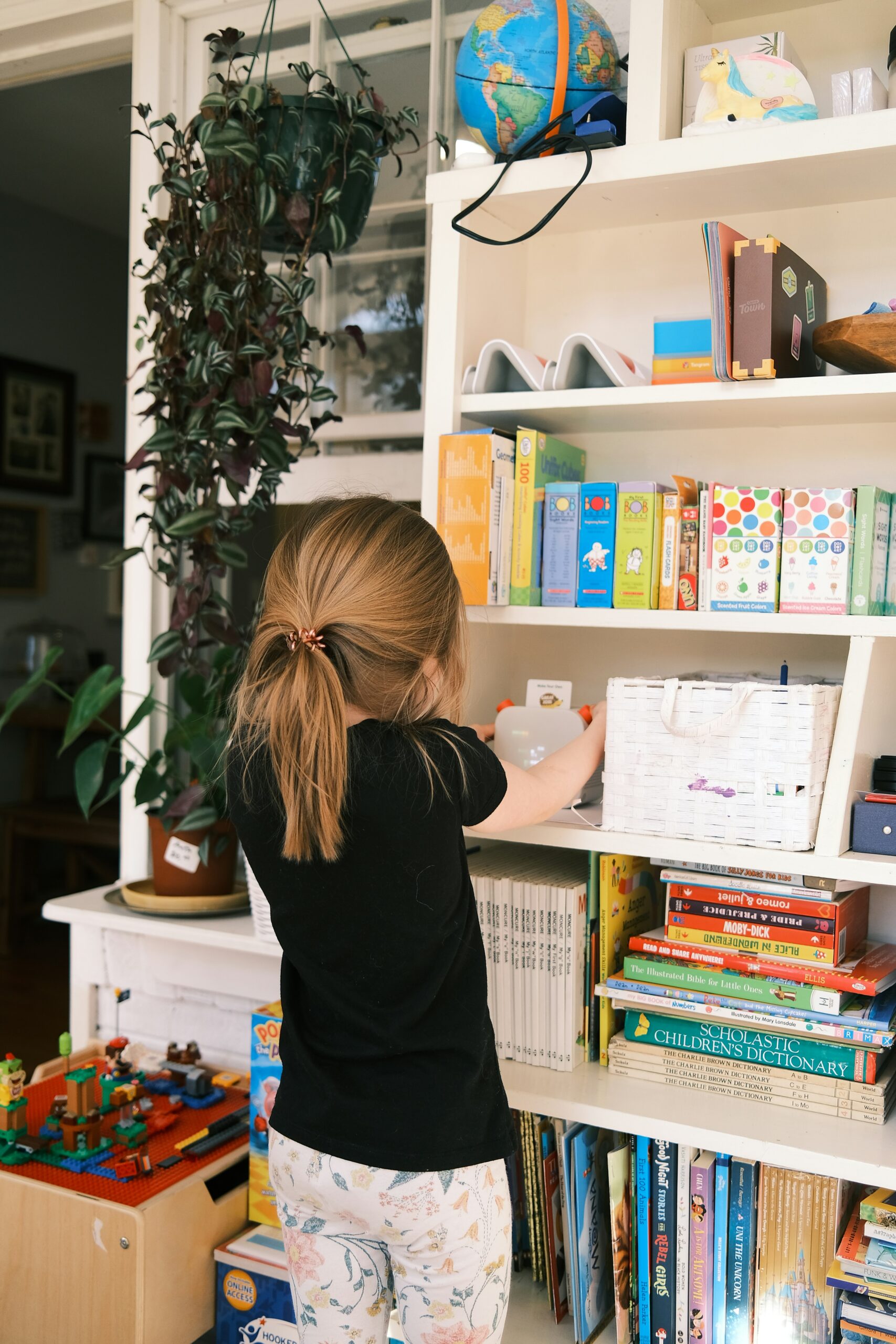
- Open shelves, low storage, and easy-to-reach materials will allow children to go straight into learning and creating with no prompts from you. I learned this strategy when my kids were babies but have carried it on into their elementary years.
- Rotating items will keep the environment fresh without overwhelming.
Zones of Exploration
- Cozy reading or “wonder” nook- Provide books about their interests will spark their love of reading just by placing them in areas they feel inclined to sit and relax.
- Building or tinkering area- Filling a few bins with blocks, magna tiles, legos or anything they can tinker with. For bigger kids I’ve found snap circuits and other stem kits to be great for initiating creativity and problem solving. My son has especially enjoyed having a space in the garage to try out real tools.
- Creative arts station- Keeping an art corner will certainly inspire curiosity. Keeping paper, drawing materials, scissors, tape, egg cartons, card board, toilet paper and paper towel tubes, popsicle sticks, play dough, stickers, glue etc. accessible throughout the day will enable your children to get creative and also write or draw when the impulse strikes.
- Nature and sensory corner- My children love to bring home treasures and display them. Designating a shelf to these objects, and including some of your own will help inspire play and create a calm space for them to explore. Try including a microscope and magnifying glass for further exploration. Use the seasons to inspire set up with books and other materials that help younger children identify the season.
- Digital exploration spot (used with intention)– Having a computer or tablet available allows them to go deeper with their interests. Online videos or websites can bring a topic to life and inspire learning. I’ve noticed my children learn a lot from basic use. Google Maps, writing in a word document, asking Siri questions, talk to text (which has helped my daughter learn to spell), the camera, etc.
Weaving in Nature: Bringing the Outdoors Into Their Learning
There is something about the outdoors that brings out the best in kids. Giving them the free time and space to explore outdoors can be a wonderful way to inspire their innate desire to learn.
- Easy additions to your space:
- 🐚Pinecones, rocks, shells, leaves, flowers.
- 🍂Nature trays for sorting, studying, or creating.
- 🪴Small live plants to care for.
- 🪺A window bird feeder or nature observation station.
- Seasonal elements to keep the environment evolving. Adding books, toys, and other materials pertaining to the season can inspire children to appreciate nature and notice the subtle differences in the changes. especially if you’re like us and don’t live in a place with much winter it can be fun to read stories about places with snow and imagine how the cold feels.
Encouraging Creativity Through Art Materials
Keeping materials open-ended encourages creativity and innovation. Process art supports emotional expression and experimentation, while allowing children to make mistakes and solve problems independently helps build resilience.
-
Ideas to include:
- ✂️ Basic supplies: paper, scissors, glue, watercolor, clay.
- 📦Loose parts: buttons, sticks, fabric scraps, cardboard.
- 🔬Tools that invite experimentation—stamps, rollers, stencils, pipettes.
Setting up a “creation invitation” table for independent exploration. Place materials where children can get messy and make it “inviting”. Kids find inspiration in all sorts of ways but sometimes need a change in their environment to encourage creativity.
Art connects to deeper learning across subjects. Leonardo da Vinci is a powerful example—though best known as a painter, he was also an inventor, scientist, engineer, and architect. His drawings and writings explored fields such as astronomy, botany, anatomy, and cartography. Similarly, I’ve noticed my children express their thinking through drawing, building and creating using materials like cardboard and glue.
Deepening Learning Through Shows, Videos, and Digital Media
- Using tech as a learning tool can be a great way to enhance learning and answer questions in a deeper way.
- This can be done by choosing high-quality educational content connected to their interests.
Examples of how to go deeper:
- 🌱Watching nature documentaries connected to outdoor finds.
- 🎨 Following tutorials related to their art or building projects.
- 📚Exploring real-world examples of what they’re curious about.
- 📺Pairing videos with hands-on follow-up activities.
Recently we needed to come up with a science project for a science fair we’re participating in with our homeschool group. We found a video to give us a thorough explanation of the topic. Then we gathered the materials to create an experiment that would solidify the learning that came along with the topic.
Letting the Environment Evolve Over Time
As children get older their needs will change. They will also have very different interests over time too. Encourage children to help redesign or refresh the space.
Regular check-ins:
-
- What’s working?
- What feels boring or cluttered?
- What new interest do they want space for?
By embracing the seasons, our children’s growth, changing passions and keeping the environment fresh, learning will continue to happen in a natural and less pressured way.
I encourage you to start small. Maybe tackle a space in the playroom to include art supplies, reading nook or building/maker space. A self-directed environment doesn’t need to be perfect. By responding to our children’s needs and interests through observation, intention and creativity they will be inspired to explore and learn in an organic way.
Comment below about how you support self-directed learning at home!
Discover more from Peaceful Purpose
Subscribe to get the latest posts sent to your email.


-
-
3 months
Tagged family, home-education, homeschool, homeschooling, language