
Navigating Unschooling: Strategies for Supporting Multiple Children’s Unique Paths
How We Unschool Multiple Children With Different Interests
Following multiple children’s interests every day might sound overwhelming. How can you possibly follow one child who is fascinated by dinosaurs while another wants to learn to sew and another wants to spend the afternoon building with LEGO?
The truth is, you don’t have to do everything for everyone all at once.
Unschooling multiple children has taught me that our days don’t need to look perfectly organized to be meaningful. Instead, we’ve created a rhythm that gives everyone room to pursue their own interests while still spending plenty of time together.
Here’s what that looks like in our home.
Maintain Anchors That Work for Everyone
While our learning is child-led, I’ve found that having a few consistent parts of our day creates a rhythm that everyone can count on.
For us, mealtimes, outdoor time, and quiet time have become our anchors.
The rest of the day is much more flexible. We might pursue individual interests, work on projects together, run errands, meet friends, or head out for an activity.
Mealtimes Become Opportunities to Learn Together
Mealtimes have been one of my favorite opportunities to introduce my children to books and ideas they might not encounter on their own.
This is often when we read history, nonfiction, science, or books about interesting people and places. There’s no expectation that we have to finish a certain number of pages or turn the reading into a lesson.
If something captures their attention, we follow it.
We might look for another book about the topic, draw pictures, watch a video, build a model, create a scene with clay, or find a way to experience the subject in real life.
One simple conversation can turn into a week of exploration—or we might move on to something completely different the next day.
Outdoor Time Is an Anchor, Too
There are so many benefits to spending time outdoors, and over the years, being outside has simply become part of our family rhythm.
My children rarely turn down an invitation to ride bikes or scooters, skateboard, run around the yard, read on a blanket, have a picnic, visit the park, or play with friends.
That may change as they get older, but for now, outdoor time remains a major part of our days.
And it doesn’t have to mean everyone is doing the same thing.
As my oldest has become less interested in playgrounds, I’ll sometimes suggest an activity we can do together while the younger kids play. She has enjoyed having that extra one-on-one time with me, and sometimes we naturally work reading or another interest into that time.
Follow the Interests That Have Momentum

One of the biggest things I’ve learned from unschooling is to pay attention to momentum.
When my children become deeply interested in a new topic or skill, they often want to return to it again and again until they feel satisfied.
I don’t have to manufacture the motivation. I just have to notice it and make room for it.
When learning to ride a bike became a major focus for one of my children, we spent much more time outside practicing than doing other activities she wasn’t particularly interested in.
The same thing happened with reading.
When she became determined to learn to read, we looked for ways to make reading part of our days and found books, games, and resources that supported what she was already trying to accomplish.
This is one of the beautiful things about unschooling: you don’t have to divide your day into equal portions for every subject or every child.
If one child is deeply engaged in something, that may be where more of our time goes for a while.
Look for Ways to Explore Interests at Home
Not every interest requires a class, a curriculum, or a long drive across town.
Sometimes the best thing we can do is make resources available at home and give our children the freedom to explore.
Books, art supplies, building materials, games, videos, music, craft supplies, and subscription boxes can all become tools for deeper exploration.
For example, science and art subscription boxes can give a child a starting point for exploring an interest more independently.
The goal isn’t to fill the house with educational products. It’s simply to make it easier for children to follow the interests that naturally arise.
Embrace the Age Gaps

One of my favorite parts of having children at different ages is watching how much they learn from one another.
The older kids often love teaching the younger ones. Sometimes the younger children simply absorb information by being around their siblings. Other times, an older child intentionally shows a younger sibling how to do something.
And sometimes an interest spreads through the family completely on its own.
One child becomes interested in learning to read, and suddenly a younger sibling wants to know what those letters are.
One child starts counting by twos, and another decides they want to try.
One child becomes fascinated by bugs, and before long, everyone is outside looking under rocks.
These are the kinds of connections I could never have planned in a curriculum.
Having multiple ages and different interests doesn’t always make learning more complicated. Sometimes it makes learning richer.
And yes, siblings will still argue.
But those arguments can also become opportunities to practice communication, compromise, conflict resolution, and problem-solving.
There is so much learning happening between siblings that we don’t have to orchestrate.
Create a Home That Supports Their Interests
Our homes can be an important part of an unschooling environment.
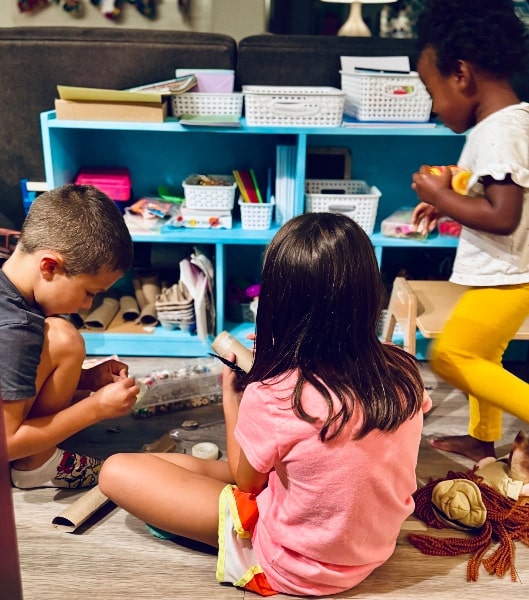
Children don’t necessarily need a perfectly designed homeschool room. They need access to resources and spaces where they can become immersed in the things they care about.
Maybe that looks like:
- A child who loves art having a reliable place to create.
- A child who enjoys music having a space to practice.
- A LEGO-loving child having somewhere they can leave a creation out while they work on it.
- A reading nook with books readily available.
- A craft cart that children can access independently.
- A shelf where ongoing projects can stay instead of having to be packed away every day.
Even better, let your children have a say in how these spaces are arranged.
When children feel ownership over their environment, they’re more likely to use it independently.
Use Outside Resources When They Add Value
Unschooling doesn’t mean we have to do everything ourselves.
Sometimes the best way to support an interest is to find someone who knows more than we do.
We use online classes, co-ops, extracurricular activities, local programs, and other community resources when they make sense for a particular interest.
Online learning can be especially helpful because it allows a child to explore something very specific without requiring the whole family to rearrange its schedule around a class.
And there’s something wonderful about connecting with other children who are excited about the same things.
The goal isn’t to fill our calendar.
It’s to bring in outside resources when they genuinely add something to a child’s learning or experience.
What If I Can’t Immediately Cater to an Interest?
This is one of the hardest parts of following children’s interests.
Sometimes a child announces that they need to learn how to fish right now, while you’re making dinner, helping another child, and trying to get everyone out the door.
We can’t always drop everything.
And we don’t have to.
One thing that has helped us is keeping a list or notebook of things the children want to explore.
When an idea comes up that we can’t pursue immediately, we can write it down.
Then we can:
- Find books about it at the library.
- Watch videos together.
- Research it online.
- Talk to someone who has experience with it.
- Look for a local class or expert.
- Plan a future outing.
- Gather materials when we have the opportunity.
If your child wants to learn how to fish, for example, maybe you can’t go fishing that afternoon. But you could find a friend who fishes, visit a local fishing shop, watch someone demonstrate it, read about different types of fish, or put a future fishing trip on the calendar.
Following an interest doesn’t mean fulfilling every request immediately.
It means taking the interest seriously.
You Don’t Have to Do It All
Unschooling multiple children with different ages and interests can feel intimidating when you imagine having to personally facilitate every single thing they want to learn.
But you don’t have to.
Your role isn’t to create a perfectly balanced educational experience every day.
Your role is to notice, listen, connect, and provide opportunities when you can.
Sometimes you’ll be deeply involved in an interest.
Sometimes your child will explore independently.
Sometimes siblings will learn together.
Sometimes you’ll find an outside resource.
And sometimes you’ll simply say, “That’s something we can figure out later.”
All of those things can be part of an unschooling life.
I’ve heard Julie Bogart say, “There are no educational emergencies.” I come back to this idea often.
We don’t have to panic because our child isn’t interested in something right now. We don’t have to force an interest because we think they should be learning it. And we don’t have to make every day look productive by someone else’s definition.
When children are given the freedom to follow meaningful interests, they may spend hours, days, weeks, or even months immersed in something.
That persistence tells us something.
They’re learning because they care.
And when we make space for that curiosity, we aren’t just helping them learn information. We’re helping them discover that they can trust themselves, pursue what matters to them, solve problems, seek out resources, and keep going when something is difficult.
That’s one of the greatest gifts I believe we can give our children.
So if you’re unschooling multiple children and wondering how you’re supposed to follow everyone’s interests, take a breath.
You don’t have to do everything.
Create a rhythm that works for your family. Pay attention to what lights your children up. Make resources available. Use your community. Let siblings learn from one another.
And trust that you don’t have to orchestrate every moment for meaningful learning to happen.
You’ve got this.
Discover more from Peaceful Purpose
Subscribe to get the latest posts sent to your email.


-
-
3 months
Tagged family, home-education, homeschool, homeschooling, language